
Why Are Data Centres Competing for Power Sector Talent in APAC?
10 Sept, 202611:16Data centre operators in APAC are pulling engineers, technicians, and grid specialists away ...


Data centre operators in APAC are pulling engineers, technicians, and grid specialists away from utilities and power producers, as electricity access has overtaken construction as the main barrier to opening new facilities. Regional capacity commitments now run into the hundreds of billions of dollars, yet transmission and generation projects take years, if not longer, to build than the data halls they’re meant to supply. This has forced companies into direct competition with power companies (and vice versa) for the same specialist power workforce, requiring proactive recruitment strategies and hiring in adjacent industries to close the gap.
Main Insights:
- Data centre electricity consumption in Asia-Pacific almost doubled between 2020 and 2024 and is expected to triple within the next few years.
- More than a third of new job postings across power and data centres target an identical set of workers, meaning power sector talent is being drawn in two directions at once.
- Grid connection timelines in markets like Singapore can stretch past 5 years for high-voltage transmission upgrades, while data centres can move from planning to energisation far faster.
- Employers are sourcing candidates from renewables, transmission and heavy infrastructure industries rather than traditional IT data centre experience.
Across APAC, data centre investment is expanding into both established markets and newer locations, attracting hyperscale development. Behind every facility lies a complex network of transmission assets, substations, and electrical infrastructure that must be in place before servers can come online. As power requirements rise, the professionals responsible for that work are attracting attention from both data centre operators and the wider energy sector.
Why are data centres becoming a major consumer of power sector talent in APAC?
The premise causing this competition is straightforward. A modern data centre is, functionally, a power plant with servers attached. As an example, Deloitte conducted research into US job postings between 2023 and 2025, identifying 39 shared occupations across technical, engineering, operations, and field-based disciplines that are heavily relied upon by both utilities and data centre organisations. These positions account for a substantial proportion of employees in each industry, with over one-third of recent vacancies aimed at candidates from the same talent pool, and this is also happening in APAC.
The overlap is actually quite natural, considering the similar skills that are required for the jobs. Electrical engineers who’ve spent careers at transmission utilities are now commissioning switchgear at hyperscale sites. Technicians trained on turbine maintenance are managing on-site generation for AI clusters. Currently, workforce availability is a major concern across both industries, with utility leaders highlighting increasing pressure to attract and retain qualified professionals, while many data centre executives identify skills shortages as their most significant hiring challenge.
Why AI growth is becoming a power sector issue
The amount of electricity available has now become the main limitation on the expansion of data centres. One NVIDIA GB200 deployment can use around 30MW continuously, a level of consumption that rivals or exceeds that of some commercial districts across Asia. When you consider that new data centre buildings now regularly exceed 100MW in an average size, it’s obvious what the problem is.
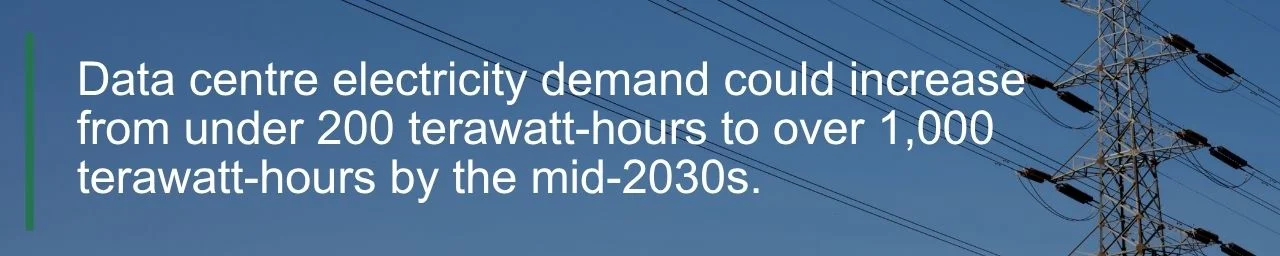
Forecasts suggest regional data centre electricity demand could grow more than fivefold over the coming decade, rising from less than 200 terawatt-hours at present to over 1,000 terawatt-hours by the mid-2030s. Much of this growth is expected to be driven by AI infrastructure, which could represent around 50% of installed data centre capacity. Demand in Southeast Asia is projected to rise by 165% by 2030 compared to levels in 2023, and in Thailand data centre power demand has grown by 400% between 2020 and 2024 even though generation capacity has only increased by 8% (Introl).
The race between data centre expansion and grid delivery
A data centre can go from site selection to energisation in a matter of years. But grid upgrades operate on a different timeline entirely. In markets such as Singapore, transmission networks can’t support the grid connections large-scale facilities need, while expanding high-voltage transmission systems can involve multi-billion-dollar investments and several years of development (Introl).
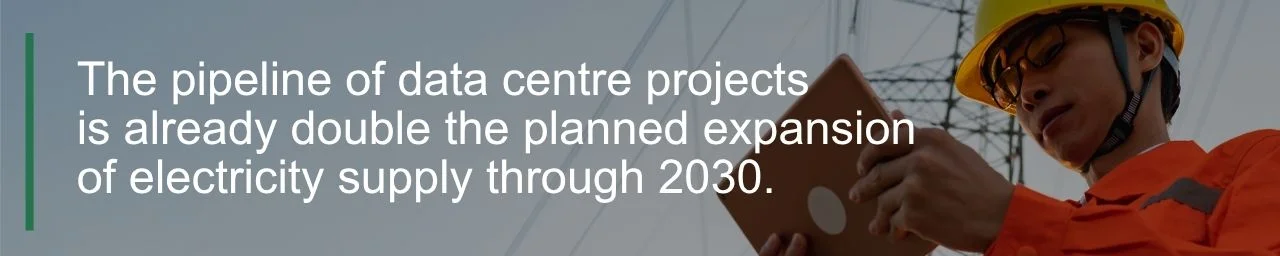
Tokyo is another example that illustrates this mismatch. The pipeline of announced data centre projects is already more than double the planned expansion of electricity supply through 2030, meaning connection delays are becoming more routine. Across a number of APAC markets, developers are facing longer waits for grid access as infrastructure upgrades struggle to keep pace with the volume of proposed data centre projects.
This gap between construction speed and grid readiness is what drives the high level of demand for power professionals. Every month a connection is delayed is a month a facility sits idle, and the people who can shorten the gap, i.e. commissioning engineers, transmission specialists, grid interconnection experts, are in short supply across the entire region.
The talent tug-of-war across APAC
Utilities, renewable energy developers, transmission project operators, and large-scale data centre companies are currently taking from the same small group of professionals. Since early 2024, major international cloud and hyperscale providers have announced regional AI and digital infrastructure investments exceeding $160 billion. Microsoft has promised to invest $25 billion in Australia between now and 2029, covering AI infrastructure, cybersecurity, and programmes aimed at developing workforce skills, while Amazon has committed $20 billion and Google is carrying out its developments in multiple Southeast Asian markets (Energy Storage News).
Places like Singapore and Hong Kong are suffering from limitations in both land and power supply, which is why investment is being directed towards other areas such as Malaysia and Indonesia. To overcome power and capacity constraints, developers are exploring alternative locations outside traditional hubs, while some operators are investing in on-site generation solutions to strengthen energy reliability. Each market that opens for data centre construction pulls on the same finite supply, often across borders, tightening hiring timelines for every employer competing at once.

The critical power roles enabling data centre growth
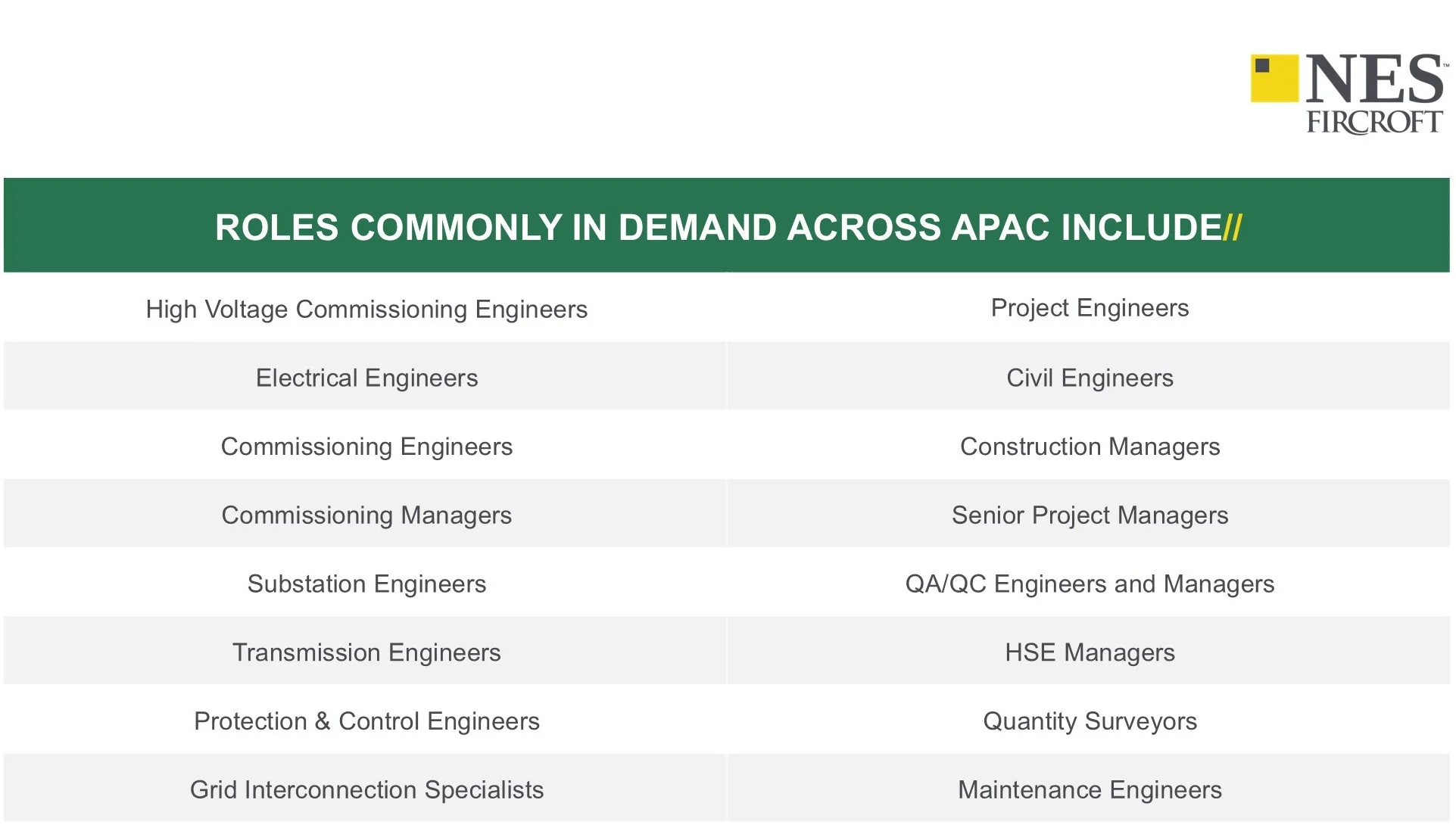
Many of the most sought-after positions sit around grid connectivity, high-voltage infrastructure, commissioning, and power system delivery. These specialists are responsible for delivering electricity safely and reliably to a facility, making them valuable to utilities, EPC contractors, substation projects, and data centre developers alike.
Case Study: Delivering high-voltage talent for a hyperscale data centre project in Malaysia
The competition for power sector talent is already evident across major APAC data centre developments. In Cyberjaya, Malaysia, a multi-phase hyperscale data centre campus project required professionals with experience across 132kV and 275kV transmission and substation works, alongside commissioning, construction, and civil engineering disciplines.
Using local recruitment capability and a regional power talent network, NES Fircroft sourced and mobilised compliant personnel to meet project requirements. We provided suitable talent for both permanent and contract roles, working in close cooperation with project leaders during the entire delivery process. In addition to recruiting, our team handled the mobilisation tasks such as applying for visas, making travel arrangements, co-ordinating accommodation, and offering support to contractors.
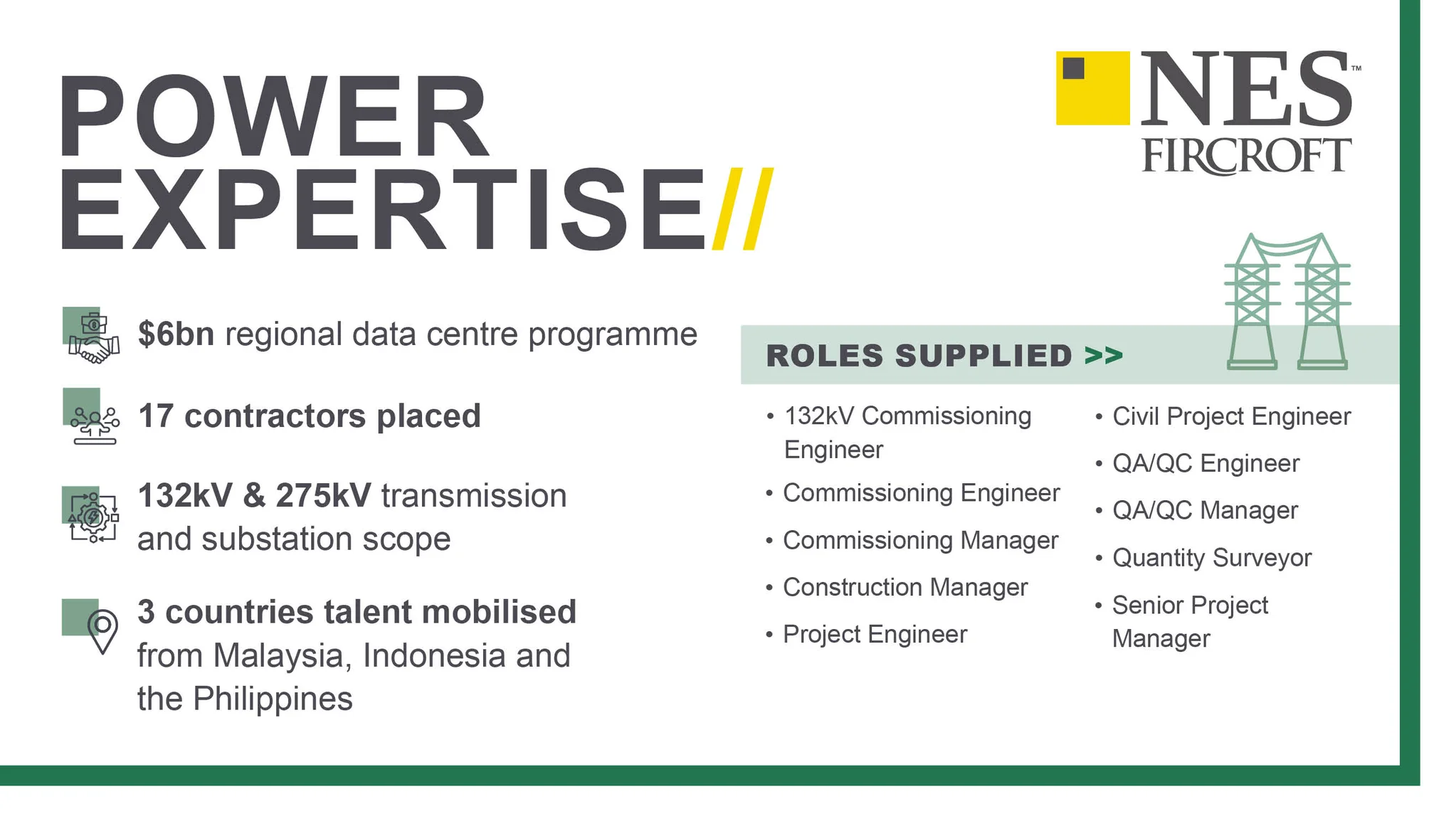
The success of the Cyberjaya project led to further opportunities in data centre development across Johor Bahru, Indonesia, and Singapore, demonstrating that demand for high-voltage and power infrastructure expertise extends far beyond a single market.
Why does adjacent-industry talent matter?
Direct data centre experience isn’t a realistic hiring requirement given how quickly demand has outpaced the specialist pool. Instead, the industry needs to look at renewables, transmission utilities, and large-scale infrastructure builds, such as mining and heavy industry, for professionals whose skills transfer directly. A power engineer who has commissioned substations for a wind farm or managed interconnection for a transmission project brings capability that maps closely onto data centre power delivery, even without a single day of colocation experience on their CV.
This opens candidate networks that would otherwise be missed. It also reduces the risk of relying on a talent segment already stretched thin by the wider energy transition.
What smart workforce planning looks like in a constrained market
Companies which plan their hiring in accordance with project schedules rather than waiting until construction has already started usually do better in this situation.
Early engagement with specialised power recruitment partners allows time to source candidates from other sectors and from overseas, where local supply is unavailable. Cross-border mobility schemes enable experienced workers to move between different markets as the various phases of a project develop. Succession planning within existing teams reduces exposure when senior power professionals are poached by competing companies. Contractor utilisation offers flexibility during peak construction phases without long-term headcount commitments, while upskilling initiatives build internal capability, reducing attrition in the long-run.
The power-first approach set out by Deloitte applies this line of reasoning at a project level. Rather than addressing power requirements after a site has been selected, developers are incorporating grid access, energy sourcing, and workforce availability into their earliest investment decisions.
Partner with NES Fircroft: Leaders in Power Recruitment
NES Fircroft has over 50 years of global experience in infrastructure and energy sectors, and has 29+ offices across North Asia, South Asia, and Australia. Our regional operations team works directly with business development and client-facing teams to keep delivery timelines realistic, backed by recruiters who focus exclusively on power sector roles.
We support you in identifying, qualifying, and mobilising talent compliantly across the region, helping ensure the power side of every project keeps pace with the ambition behind it.
Get in touch with our team to discuss your next power workforce requirements.