Renewable Energy Growth in Australia: Market Expansion and Recruitment Trends
19 Dec, 202511:25Key Takeaways: Renewable energy generates over a third of Australia’s electricity, and ...

Key Takeaways:
- Renewable energy generates over a third of Australia’s electricity, and that share is set to rise to around 82% by 2030.
- Replacing coal with renewables will require 6GW of new generation capacity each year this decade.
- The renewable workforce is expanding fast, but skills shortages are emerging across electrical, mechanical, and project management roles.
- Workforce challenges include regional labour constraints, project-based work patterns, and long training timelines for technical trades.
- Australia will need both domestic training and investment and skilled migration to meet energy goals.
The Momentum Behind Australia’s Energy Transformation
Australia’s energy system is changing faster than at any point in its history, primarily due to legacy power systems, such as the country’s coal-fired stations, which are expected to reach the end of their operational lives by 2030. In their place, a new mix of wind, solar, storage, and flexible gas generation will form the foundation of the national grid.
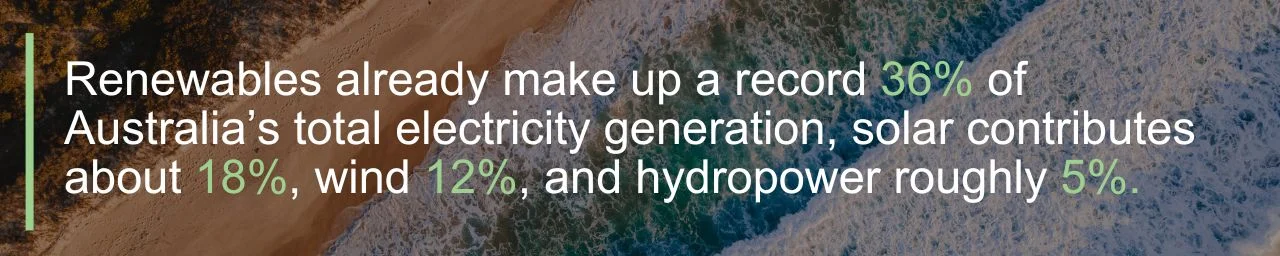
Renewables already make up a record 36% of Australia’s total electricity generation, solar contributes about 18%, wind 12%, and hydropower roughly 5%. These figures represent a doubling of renewable generation in the past decade and a five per cent increase in just the last year.
The Australian Government’s ‘Future Made in Australia’ plan aims to position the country as a renewable energy “superpower” by 2050. The goal is underpinned by practical policy and investment to support utility-scale solar, both onshore and offshore wind, and large-scale storage projects.
The Australian Renewable Energy Agency (ARENA) is also supporting the sector by funding pre-commercial innovation and new technologies, such as hydrogen and long-duration storage, to move from pilot to deployment.
Why is Australia Well-Placed to Lead?
Several factors give Australia a competitive edge in renewable energy development:
- Abundant natural resources – the continent has the world’s highest solar radiation and vast wind corridors across its coastlines and interior.
- An integrated energy market – a single national electricity market allows new technologies to connect and compete more efficiently than in fragmented systems overseas.
- Open trade conditions – Australia has avoided the clean energy trade barriers seen elsewhere, which keeps technology costs down and enables faster deployment.
- Government-backed initiatives – Renewable Energy Zones (REZs) and the national Capacity Investment Scheme, designed to support 23GW of new generation and 9GW of new storage by 2030.
These advantages translate into measurable growth. Market research shows installed renewable capacity is expected to double from 74.8GW in 2025 to nearly 149GW by 2030, representing a CAGR of around 15%. According to the Clean Energy Council, in 2024 alone, investment commitments for large-scale renewable energy increased by 500%, rising from $1.5bn to $9bn, reflecting improved economic conditions and clear policy frameworks. At the end of 2024, 59 large-scale projects were under construction, totalling around 9.9GW of capacity and spanning solar farms, onshore wind installations, and biomass operations.
By geography, New South Wales and Victoria currently account for 45% of installed capacity, while Queensland is projected to grow the fastest, driven by investment in large-scale solar and corporate clean energy commitments from mining and data centre operators.
The Workforce Challenge
As new renewables capacity comes online, Australia’s transition requires a six-fold increase in utility-scale renewable generation and a sixteen-fold increase in energy storage capacity over the coming decades (AEMO). Meeting this will require coordinated construction, commissioning, transmission upgrades and long-term operations support.
Employment data already shows the sector’s acceleration. The Australian clean energy workforce has seen a 120% increase over the last decade, with more than 26,800 direct FTE renewable energy jobs recorded. However, workforce supply hasn’t kept pace with demand. Jobs and Skills Australia identifies 38 occupations critical to the clean energy transition. These range from electricians and engineers to construction managers, metal fitters, machinists, and project leaders. Every major renewable development relies on a combination of these skillsets, increasing the competition for labour.
By 2030, 85,000 workers will be needed in renewables, and more than half of those roles are occupations already facing shortages. Around 194,000 people will need additional training for new skills across solar, wind, hydrogen, and storage (Australian Industry Energy Transitions Initiative).
The investment required to deliver this transformation, an estimated $427 billion in combined capital expenditure from the government and industry, will create ample opportunities, but also sustained competition for skilled labour.
Why Are Renewable Energy Skills Hard to Source?
1. Long Training Pipelines and Licensing Requirements
Key trades, such as electricians and engineers, require at least 3-4 years of training before reaching independent accreditation. Training capacity cannot easily be expanded overnight, especially given that renewable projects often have short lead times from approval to construction.
2. Regional Labour Shortages
Most of Australia’s large-scale projects are located in designated REZs, regional clusters where local populations are smaller and there’s stronger competition for labour. Mining, manufacturing, and civil infrastructure projects in these same areas often draw from the same talent pool.
3. Short-Term Contracts
Many renewable construction projects last only 12 to 18 months. This short window makes it difficult to take on apprentices or invest in training for temporary workers. Contractors, facing pressure on costs and deadlines, often rely on short-term labour hire, which can limit skill development and retention.
4. Low Workforce Mobility
Renewable workers often move from project to project, but employment conditions such as portable entitlements aren’t yet standardised. This limits continuity and makes long-term career paths less clear compared to established sectors like construction.
5. Skills Transfer Gaps
Even when workers come from adjacent sectors, such as civil works or manufacturing, they often require additional training for renewable applications.
What Needs to Change?
To tackle these challenges, a long-term approach to workforce development is essential. That includes:
- Investing early in training and apprenticeships, particularly in high-demand technical roles.
- Encouraging mobility between sectors, while ensuring workers are supported through structured skills transfer.
- Supporting skilled migration to fill critical gaps. While upskilling and reskilling the domestic workforce remains a priority, industry consensus is that migration meets immediate needs. International specialists can deliver knowledge transfer, helping local teams enhance their skills and capabilities.
This doesn’t replace local employment; rather, it helps stabilise project delivery so local workers can be trained and retained within the industry.
Government work on the National Energy Workforce Strategy (NEWS) is a step in this direction, which sets out a framework for skills development through to 2050. States are also moving ahead with their own plans, such as Victoria with its Energy Jobs Plan and New South Wales with its 2030 Renewable Energy Workforce Plan (Clean Energy Council).
In addition, the First Nations Clean Energy Strategy aims to create equitable partnerships and increase workforce participation in communities that host many of these projects.

What Does This Mean for Employers and Decision-Makers?
For developers, EPCs, and energy operators, the workforce challenge is both a risk and an opportunity.
Without coordinated planning, skills shortages can delay commissioning and increase costs. But for organisations that move early, establishing partnerships with training providers, exploring global mobility solutions, and building relationships with workforce experts, there’s a clear competitive advantage.
There’s a shift in how companies think about renewables recruitment. It’s no longer a transactional process of filling roles, but a strategic discussion about capability:
- Where can skills be developed internally?
- When should overseas specialists be brought in?
- How can contractors and permanent teams work together more effectively across multiple sites?

How NES Fircroft Supports Australia’s Renewables Industry
With a long-standing presence in Australia’s energy and infrastructure sectors, NES Fircroft supports clients through every stage of project delivery, from design and engineering to commissioning and operations. Our teams in Brisbane, Melbourne, Perth, and Sydney are firmly integrated within their respective local markets. This positioning enables us to provide customised workforce solutions throughout Australia's renewable energy sector.
Our expertise spans:
- Technical recruitment across renewable generation, storage, and transmission
- Workforce mobility, immigration, and visa support
- Contractor management and ensuring compliance
- Strategic workforce consulting to build strong candidate pipelines
Contact us today to learn how we can support your workforce needs across the renewables industry.
FAQs
What is driving Australia’s increasing investment in renewable energy?
The combination of ageing coal assets, strong solar and wind resources, and clearer national and state policies has made renewable generation more economical and practical to build. Investment conditions improved significantly in 2024, resulting in a sharp increase in project commitments.
How much new generation capacity does Australia need each year?
The Australian Energy Market Operator estimates that the system will require around 6 GW of new utility-scale generation annually to replace retiring coal plants and meet future demand. This includes wind, solar, and the storage needed to support them.
Which skills are currently hardest for employers to secure?
Technical electrical and mechanical skills remain the most constrained, particularly licensed electricians, electrical engineers, and workers with experience in high-voltage systems or wind and solar construction. These occupations appear on Jobs and Skills Australia’s list of 38 roles considered critical to the transition.
Why are many of Australia’s renewable projects affected by regional labour shortages?
Large projects tend to be built in regional REZs, where the local workforce is often small and shared with established industries, such as mining and manufacturing. Short projects also mean workers move on quickly, limiting long-term capacity in those areas.
Will Australia rely solely on local training to meet future workforce needs?
No. While local training and apprenticeships are expanding, current forecasts indicate that domestic supply alone will not meet demand. Skilled migration will remain important, especially for specialist engineering and technical roles that require years of experience.