Data Centers: Hiring Trends and Skills Demand
12 Feb, 2026

Key Takeaways: Mining companies across North and South America are turning to renewable...


Mining remains a vital component of many national economies across the Americas, particularly in the United States and Canada, which are increasingly relying on minerals for electrification and the energy transition. Both countries assume an outsized role in supplying minerals, and they anchor much of the global investment and corporate leadership in the sector.
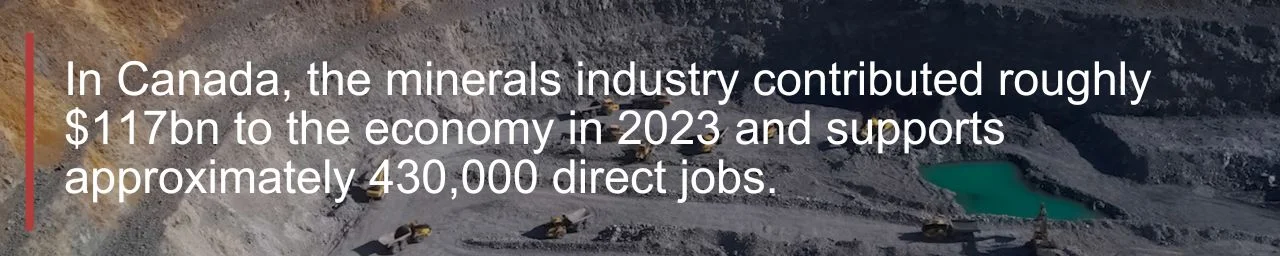
Most prominently in Canada, the minerals industry contributed roughly $117bn to the economy in 2023 (~4% of national GDP), and supports approximately 430,000 direct jobs, with the mining sector serving as a major employer in northern and Indigenous communities. The federal critical minerals strategy now identifies 34 minerals as essential to Canada’s economic and energy future, thereby strengthening its role in supplying the clean-energy supply chain.
Across the United States and Canada, investment and exploration activity continue to expand, driven by climate targets, cost control, operational stability, and energy security. These markets also serve as the operational base for many mining companies active across Latin America, making it a complementary region. As highlighted by the International Energy Agency, Latin America produces approximately 40% of the world’s copper and 35% of lithium.
However, this growth is accompanied by rising expectations around environmental management, community impact, and long-term sustainability. Renewable integration has therefore become a priority for miners, one motivated by climate targets, cost control, operational stability, and energy security.
Mining is an energy-intensive industry, with energy accounting for 15-40% of operational costs on average. As the share of renewables in global power rises, the average amount of minerals needed per power unit has increased, tightening the link between mining and renewable energy demand. Historically, operations have depended on diesel or heavy-fuel generators, especially in remote and off‑grid regions such as Northern Ontario, Northern Quebec, Saskatchewan, Nunavut, New Brunswick, and the northern BC/Yukon corridors in Canada, as well as Nevada and Arizona in the United States, and Alaska which particularly faces challenges such as extreme climates and strong local-hire expectations. As fuel markets fluctuate, mining companies have accelerated the shift toward renewable power to reduce volatility and emissions. In fact, 88% of new renewable capacity installed at mines has been in North and South America, driven by decarbonization and cost control imperatives.
These long-term contracts also protect operators from volatile energy pricing. (Source for projects: Power Technology)
GlobalData identifies 886 active and upcoming off-grid mines that will require on-site renewable capacity to decarbonize electricity supply. Technologies include:
Energy storage is essential in remote renewable systems. Mines are deploying:
Intermittency and storage capex remain hurdles, but utility-scale storage is increasingly the key enabler of stable, renewable-powered remote mining. Developers are addressing these barriers through optimized hybrid designs, modular storage, and microgrid control systems, often balancing site-specific irradiance and wind profiles (Solar Spaces).

While renewable integration increases, mining companies across the Americas region face significant workforce challenges.
Nearly half of the US mining workforce is expected to retire in the next decade, and in Canada, only 5% of mining workers are under 25, reflecting a shrinking pipeline (Sandvik Talent Report). Across OECD countries, 72% of the mining workforce is over 35, compounded by declining enrolments in mining engineering programs, which have fallen by 39% in the US since 2016.
A 2023 McKinsey study found:
The equipment mix at sites is also creating another skills shortage: as of April 2025, 958 electric mining equipment units were in operation worldwide, including 386 battery-powered mining trucks, which reinforces the need for electrical and power electronics skills.

Modern candidates seek flexibility, clear career development and technology-enabled roles. Remote operating centers (ROCs) allow centralized oversight across the value chain, enhancing decision-making and opening roles to people who don’t need to live on-site. They’re integral to reshaping operating models and enabling flexibility, both for ESG and talent attraction. As Carly Leonida from The Intelligent Miner puts it, mining today “has less to do with picks and shovels and more to do with data,” highlighting the importance of AI, analytics, and automation in modern roles. The industry must reposition itself to attract talent who may otherwise choose to work in other technology sectors.
Remote sites remain difficult to staff due to:
These factors contribute to a geographic mismatch between where talent lives and where mines operate. Companies increasingly rely on specialized mining recruitment agencies and technical subcontracting to ensure compliant mobilization and to fill critical roles.
Mining provides direct pathways for local talent to secure high-paying jobs within the economy. As mining operators develop their projects, there are opportunities to help engage local workers and young people in developing the expertise necessary to become skilled professionals in their communities.
To meet production targets and integrate renewable infrastructure, operators must strengthen their workforce strategies by combining targeted recruitment, upskilling, and robust mobilization support.
For region-specific mobilization services, see our expertise in North America and Latin America.
As automation and electrification expand, companies are generally prioritizing (as a non-exhaustive list):
Additionally, and particularly evident in Canada, several recurring hiring challenges tend to create bottlenecks. These include:
The most effective recruitment programs for remote sites include:
Explore our integrated approach to mining recruitment and renewable energy recruitment.
As solar-wind-storage hybrid systems become more common, competencies in high-voltage systems, power electronics, battery management, microgrid dispatch, and predictive maintenance are becoming increasingly essential. Practical experience with site microgrids, energy management systems (EMS), and hybrid controls will be central to achieving stable operations at off-grid mines, where utility-scale storage addresses intermittency and demand spikes.
NES Fircroft delivers recruitment, mobilization and project workforce solutions to mining operators, EPC partners and renewable developers throughout North America.
We support clients through:
To mobilize specialized talent for your renewable-powered mining projects, contact our team today.
Specialized mining recruitment agencies provide technical search, local and global talent sourcing, mobilization support, and expertise in staffing off-grid operations. NES Fircroft support both permanent and contract hiring, including relocation arrangements and multi-country assignments.
Yes. Talent shortages are significant across the Americas, with 71% of mining leaders reporting difficulty meeting production targets due to staffing challenges, and 86% experiencing increased hiring difficulty in the past two years. If you’re interested in transitioning sectors or looking for a new role, browse our latest opportunities here.
Hybrid solar-wind systems combined with battery storage are the most common. Solar PV provide cost-effective daytime power, wind adds night-time generation, and lithium-ion or pumped-hydro storage ensures continuity when conditions fluctuate.
To reduce energy costs, stabilize supply in off-grid regions, meet ESG expectations, and decrease reliance on diesel. PPAs and on-site renewable plants are currently major drivers of adoption across the Americas.
Key roles include electrical engineers, energy storage specialists, solar and wind technicians, automation experts, digital systems engineers, and ESG professionals, as well as ROC operators and microgrid engineers, who are in rising demand as mines integrate hybrid systems and electric fleets.