Top Recruitment Challenges in France
16 Mar, 2026


Key Takeaways: Data center construction activity is increasing across the US and Canada...

The data center market across North America is undergoing a scale of expansion that is influencing every part of the talent landscape. The US is forecast to see its total capacity increase more than threefold based on current project pipelines, with Canada also preparing for sustained growth across several provinces. Investment by major technology firms is increasingly directed toward power‑rich but less populated locations, where demand for engineering and construction talent already exceeds supply, adding pressure to workforce availability and delivery timelines.
Many of the largest data center projects in the US (Abilene, Texas; Doña Ana County, New Mexico; Port Washington, Wisconsin), along with major developments in Canada (mainly Ontario, Quebec, and Alberta), are being built to meet power requirements, often located near transmission infrastructure or in areas where more grid capacity is available. McKinsey has estimated that demand for high-density data center capacity in the US could increase by around 33% per year, depending on the scenario. Meeting this level of demand means construction teams need to be available for long project timelines, often moving between sites as build phases progress.
As more projects cluster around power-rich regions, competition for electrical engineers, high-voltage specialists, commissioning professionals, and Mechanical Electrical and Plumbing (MEP) supervisors intensifies. In this scenario, projects are competing for the same groups of skilled workers, particularly in areas where population density is low.

Large technology, cloud, and advanced computing companies are continuing to erect new data center facilities at pace. In some cases, these projects require workforce numbers similar to those seen on large industrial programs. Some developments, including the Stargate hyperscale project, are expected to run for several years, and project timelines can extend further depending on planning approvals and the availability of grid connections.
During construction, one facility can require up to 1,500 on-site workers, followed by permanent engineering and O&M staffing once operational. This scale of activity is contributing to hiring pressure, with organizations approaching the same limited talent pools.
Uptime Institute research shows that staff shortages are most noticeable in mid and junior-level operations roles and also points to longer-term issues linked to workforce age profiles. North America is among the regions where employees over 55 outnumber those under 30, meaning retirements will remove experience that is difficult to replace. As data centers become more complex, this shortage becomes more pronounced. Companies that previously relied on internal promotion are now looking externally at a time when the market offers fewer available candidates.
Pay levels have increased across many data center roles, with some positions in the US now offering salaries in the six-figure range. While this has helped to attract talent, it has also contributed to increased movement between employers, as professionals are willing to move for better-paid opportunities. Industry surveys show a high level of mobility, with a significant proportion of data center professionals either planning a move or having changed roles recently.

The Bureau of Labor Statistics reports that thousands of additional construction workers will be needed through 2033. This includes electricians, power infrastructure specialists, and HVAC technicians, all of which are involved in data center construction. Across the sector, there’s limited spare capacity and a large backlog of work, and as a result, many employers have far less flexibility to reassign teams between locations.
Developers are selecting remote locations for new facilities where grid capacity is more favorable, with expansion moving into regions away from established talent hubs. In the US, this includes sites such as those in Abilene and College Park, GA - reflecting a shift toward areas positioned farther from major metropolitan centers. Similarly, in Alberta, developments are underway in farming communities such as Lethbridge, Pincher Creek, Olds, Bonnyville, and Cold Lake. Mobilizing skilled workers across states or provinces has become a routine requirement, often at short notice, which places greater emphasis on recruitment partners with global reach and established regional networks, such as NES Fircroft.
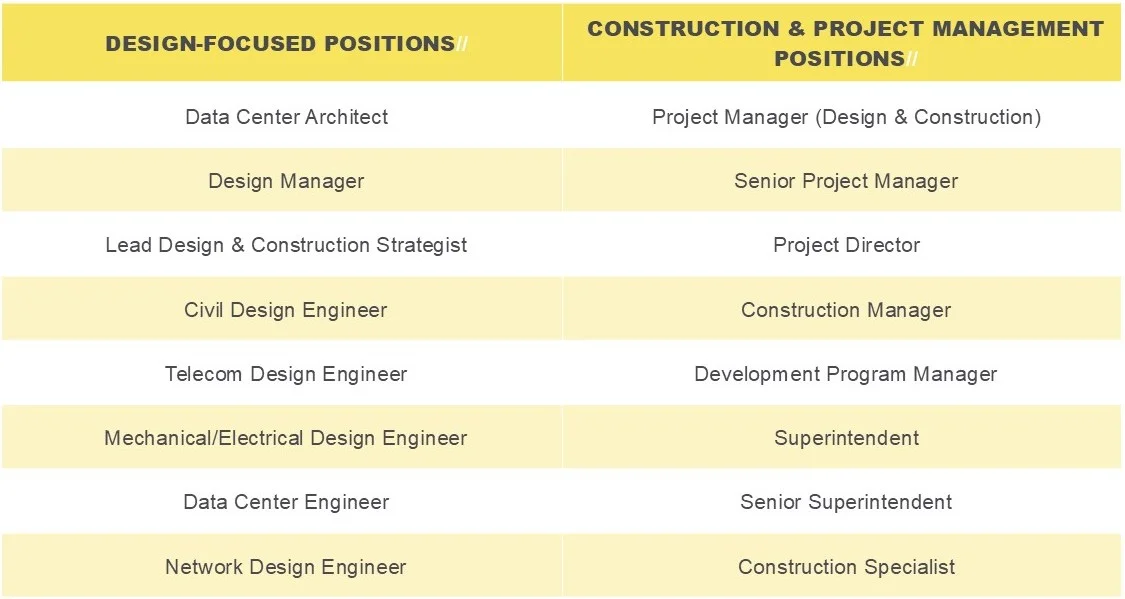
Our data center recruiters have identified the following in-demand roles across the US and Canada:

Based on NES Fircroft’s recruitment activity across North America, we believe these three major developments will shape the labor market:
Most current hiring activity in the data center sector is focused on design and construction roles with leadership responsibility. Employers regularly report difficulty hiring design engineers, project managers, construction managers, and commissioning professionals. As a result, many projects rely on workforce arrangements that can be scaled up or reduced as construction schedules change.
Many new projects are sited in locations where local labor pools are smaller. NES Fircroft can mobilize skilled workers across national borders and from other regions through our established global network, providing the talent needed for specific projects. Data center developments often require large volumes of engineers and construction staff in short timeframes, demanding a more tailored approach to hiring. Through Project RPO, we design recruitment processes that scale with each phase of the build, ensuring teams are in place when project milestones require them. For developers entering new markets, our Employer of Record solution enables fast, compliant hiring even without a local operating entity.
Particularly as we see more Asia‑based developers expand into the Americas, EOR provides a smooth route to mobilize teams and begin work immediately.
A shortage of construction workers is expected to continue through this decade, likely affecting how quickly new data center sites can be completed. Construction progress depends on the availability of power infrastructure workers, electricians, and HVAC specialists. Where these skills are in short supply, build schedules can slow. NES Fircroft expects workforce planning to become a strategic exercise rather than a transactional hiring process.
NES Fircroft supports data center projects from early design and construction through to long‑term operations. With more than 15 offices across North America, backed by teams in over 45 countries, we help projects access experienced talent even where local hiring capacity is limited.
We source both regional and international professionals aligned to US and Canadian requirements, which allows teams to mobilize quickly into power‑led and less established locations. Depending on project scope and timing, support may involve targeted contract hires, project RPO, or permanent recruitment across engineering, construction, commissioning, and O&M roles.
Case Snapshot:
We recently supported a North American OEM by mobilizing six experienced O&M engineers across three US sites, helping stabilize operations while capacity expanded.

If you’re planning or delivering a data center project and need specialist hiring support, contact us today and speak to our dedicated North American data center recruitment teams, who can help you build and scale the right workforce.
Staffing levels vary widely depending on the stage of the facility and the complexity of the build. During construction, large data center projects can employ hundreds or even thousands of workers across multiple disciplines. Once operational, headcount drops, with teams typically focused on mechanical and site operations.
Technical expertise in power systems, cooling technology, mechanical and electrical engineering, networking, and commissioning are core areas. These apply to the top roles in demand, including construction management, project engineering, project management, OFIC and project coordinators, and project controls. Non-technical skills, such as problem-solving and teamwork, also feature prominently, with nearly half of the required competencies falling outside pure engineering.
Demand for high‑density compute and reliable power continues to underpin data center development, even as individual projects face delays related to permitting, grid access, or workforce availability. Overall activity remains concentrated in regions able to support large‑scale power requirements.
An aging workforce, rising project volume, and strong competition across industries for similar skills limit the availability of talent, while specialist roles often require long lead times to develop.
For projects located away from established labor markets, most operators look beyond the immediate local workforce. This often involves mobilizing workers from other regions or countries and planning workforce needs earlier in the project lifecycle. NES Fircroft provides comprehensive recruitment and full mobilization services, including Project RPO, EOR, logistics support, and international hiring where required.