10 Books Every Engineer Should Read
08 Oct, 202610:37Which books should every engineer read? The best engineering books combine technical cr...


Which books should every engineer read? The best engineering books combine technical craft with lessons on design, failure, systems thinking and career growth. If you are looking for reading recommendations, this blog, although not an exhaustive list of engineering books, looks at 10 books every engineer should have on their radar. They suit engineers in energy, manufacturing, construction and software, at any career stage.
Regardless of what engineering discipline you practice or how senior you are, all these books should prove useful and interesting if you work in the engineering profession. One of them might even prompt you to look for a new role.
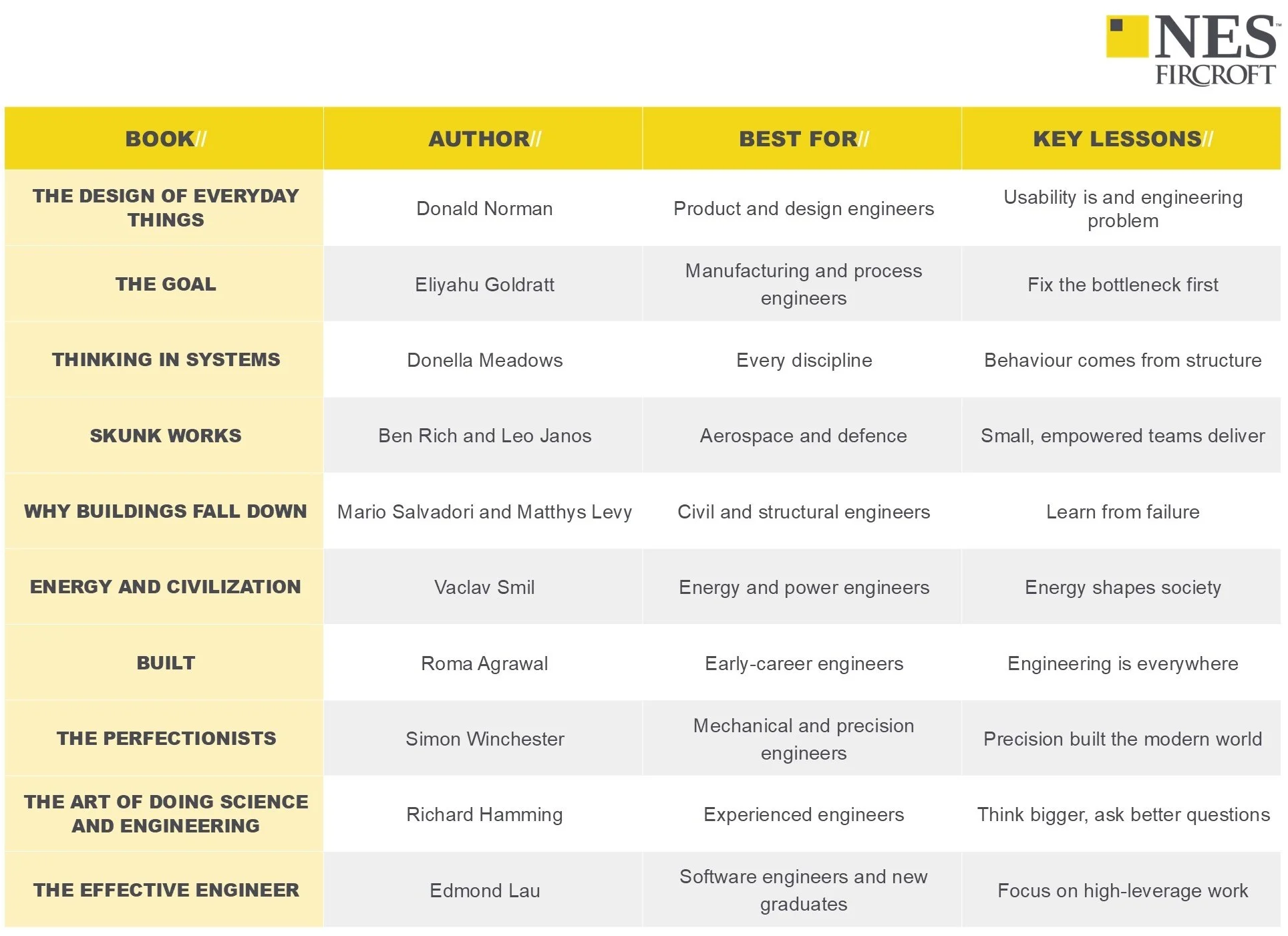
Quick Guide: The Best Engineering Books at a Glance
1. The Design of Everyday Things
By Donald Norman | Non-Fiction | 368 Pages
Best for: product, mechanical and software engineers.
Cognitive scientist Donald Norman explains why things are designed the way they are and how to make products that are useful. First published in 1988 and revised in 2013, it shows how purely aesthetic design can sometimes ruin how products work and emphasises the importance of user experience and functionality. Relevant for engineers involved in making anything, from a bridge to an app.
2. The Goal: A Process of Ongoing Improvement
By Eliyahu Goldratt | Fiction | 376 Pages
Best for: manufacturing, process and operations engineers.
Although this book has a manufacturing focus, it will have any engineer thinking about efficiency and design. It focuses on the Theory of Constraints and bottlenecks but presents the information in a digestible way, written as a piece of fiction.
The business novel follows plant manager Alex Rogo, who oversees a production plant where scheduling is a problem, and he is tasked with turning the operations around in only 90 days, or corporate HQ will close it down. It is especially relevant if you work in industry or manufacturing, but also if your role includes any type of process change and improvement.
This story has even been made in a graphic novel format, meaning those of you less fond of large bodies of text can delve into something more visually stimulating.

3. Thinking in Systems: A Primer
By Donella Meadows | Non-Fiction | 240 Pages
Best for: engineers in every discipline. New to this list.
Engineers rarely work on isolated components. Donella Meadows explains how feedback loops, delays, stocks and flows drive the behaviour of complex systems, from power grids to supply chains. It is short, clear and largely jargon-free, and it gives you a vocabulary for explaining why well-intentioned fixes sometimes make problems worse.
4. Skunk Works: A Personal Memoir of My Years at Lockheed
By Ben Rich & Leo Janos | Non-Fiction | 416 Pages
Best for: aerospace, defence, and project engineers.
If you didn’t know already, the Skunk Works is Lockheed Martin’s famous group that works on some of the most pioneering technology and aircraft, often veiled in secrecy. The group was founded by Kelly Johnson, who led the designs for 40 civilian and military aircraft, including the U-2 and the SR-71 Blackbird.
Ben Rich was the boss of the Skunk Works for nearly two decades, and his book recounts the group's brilliant stories, inevitably including countless accounts of extraordinary engineering achievements, such as the production of the F-117 stealth aircraft, which Rich oversaw.
5. Why Buildings Fall Down
By Mario Salvadori & Matthys Levy | Non-Fiction | 352 Pages
Best for: civil and structural engineers, though every discipline benefits.
Although the focus of this book is on structural engineering, and specifically the various reasons buildings have failed, it also analyses the interactions between people, nature, and materials.
Each chapter takes on a different theme and analyses case studies of failure and success, but the book's underlying theme is the necessity of learning from past mistakes so as not to repeat them, and thus it is an essential read for all engineers, no matter the discipline.
6. Energy and Civilization: A History
By Vaclav Smil | Non-Fiction | 568 Pages
Best for: energy, power and renewable engineers. New to this list.
Smil traces how humanity’s use of energy, from human muscle and firewood to fossil fuels and electricity, has shaped economics and societies. It’s dense but rewarding and gives anyone working in the energy transition a valuable perspective on how slowly and how profoundly energy systems change. It’s especially relevant given how many engineers now work in renewables, nuclear, and hydrogen.
7. Built: The Hidden Stories Behind Our Structures
By Roma Agrawal | Non-Fiction | 320 Pages
Best for: early-career engineers and curious generalists.
Shedding light on just how much engineering impacts everything we encounter in our daily lives, Built is a breezy, digestible read that interweaves science, history, illustrations, and personal stories to explore how engineering has evolved from the mud huts of our ancestors to steel skyscrapers that tower over our cities.
Written by structural engineer Roma Agrawal, one of the brains behind The Shard, this book explores several great engineering challenges across eight chapters. It’s a good reminder of why many of us entered the profession in the first place.

8. The Perfectionists: How Precision Engineers Created the Modern World
By Simon Winchester | Non-Fiction | 416 Pages
Best for: mechanical, manufacturing, and precision engineers.
Delving into the importance of precision and perfectionism in engineering, this book walks the reader through key moments in history when precision led to greatness. From the Industrial Age, when modern production was a new phenomenon, to the modern day, Winchester introduces the engineering minds and intricate methods that have changed the world throughout history.
9. The Art of Doing Science and Engineering: Learning to Learn
By Richard Hamming | Non-Fiction | 432 Pages
Best for: experienced engineers and technical leaders.
Written by leading computational scientist, Richard Hamming, whose work inspired a generation of engineers, scientists and researchers, this book delves into a particular mindset and thought process that breeds great ideas. Hamming explores his successes and his failures and encourages fellow scientists and engineers to do amazing things by changing the way they think.
Originally published in 1996 and adapted from a course Hamming taught at the US Naval Postgraduate School, this book is an insightful read filled with inspiration and motivation to adapt your thinking and advance your career. The content and style of this book lend themselves to the more seasoned engineer, covering many technical aspects of the industry.
10. The Effective Engineer: How to Leverage Your Efforts In Software Engineering to Make a Disproportionate and Meaningful Impact
By Edmond Lau | Non-Fiction | 260 Pages
Best for: software engineers and anyone new to the industry.
This book discusses techniques that can make both junior and senior software engineers more effective and successful in their work. While the focus falls on software engineers, many of the principles outlined in this book can be applied to other engineering disciplines, professions, and life in general.
Particularly helpful to those new to the industry, this book shares a collection of stories from Instagram, Quora, Google Docs, Facebook and more. Lau takes these stories and turns them into actionable habits and lessons that the reader can take forward in their career.

Why Should Engineers Read Beyond Technical Textbooks?
Technical knowledge gets you through the day-to-day, but careers are shaped by judgement, communication, and the ability to see how your work fits into a bigger picture. Books on design, failure, and systems thinking build exactly those skills. They also give you a shared language for working with colleagues in other disciplines, which matters on large energy, infrastructure, and manufacturing projects where engineers from many backgrounds collaborate.
Reading is also one of the simplest forms of professional development. Whether you’re a contractor moving between projects or a permanent employee planning your next step, a good book can broaden your perspective without needing time away from work.
Take the Next Step in Your Career
NES Fircroft’s expert recruitment teams place engineering and technical professionals in global roles with some of the biggest names in energy.
If you’re looking to take the next steps in your engineering career, you can view our open vacancies or register your CV with us today for free to ensure that you’re first in line for future jobs in this expanding industry.
Related Posts

Top Data Centre Projects in the Middle East
28 Sept, 2026